
Hot Tub Electrical Installation in Sisters, OR
Cold Nights in Sisters Deserve a Hot Tub That Actually Works
Hear from Our Customers
Hot Tub Wiring Sisters, Oregon
Sisters gets real winters. January overnight lows regularly drop into the low-to-mid 20s, and when the snow settles in around Tollgate and Crossroads, a hot tub stops being a luxury and starts being the whole point of having a backyard. Getting the electrical work done right — and done before the cold season — means you are not sitting on a hot tub you cannot use when the temperature finally gives you a reason to.
Beyond the timing, the quality of the installation matters more here than most places. Freeze-thaw cycles at this elevation put stress on outdoor electrical components over time. Properly weatherproofed conduit, outdoor-rated disconnect boxes, and tight, code-compliant connections are not just code requirements — they are what keeps a Sisters installation holding up through years of real winters, not just the first one.
For the vacation rental owners in Black Butte Ranch, Tollgate, and the surrounding communities, there is also a straightforward business case. Hot tubs are one of the most-searched amenities on short-term rental platforms, and a properly wired, permitted, and inspected hot tub can meaningfully increase both nightly rate and occupancy. A failed inspection or a tripped breaker during a guest stay costs you reviews and revenue. Getting it done right the first time protects both.

Ready to get started?

Hot Tub Electrician Sisters, OR
Young Electric LLC is a second-generation, family-owned electrical contractor with over 40 years of combined experience. We grew up in this trade — and that kind of institutional knowledge shows up in how the work gets done, not just how it gets quoted. We already serve Bend and Sunriver, which puts Sisters squarely in the territory we know well, not a market we are stretching to reach.
We hold both an Oregon CCB license and a BCD electrical license — the two credentials Oregon requires for this type of work. Every installation we perform is permitted, inspected, and backed by a 5-year warranty on labor. That warranty is not something you will find offered by other electricians serving the Sisters area.
With over 1,400 Google reviews averaging 4.8 stars and a BuildZoom score that places us in the top 1% of all Oregon contractors, our track record speaks for itself. When you are choosing a contractor for a vacation rental property or a home in a community like Black Butte Ranch, that kind of verifiable history matters.

240V Hot Tub Wiring Process Sisters
It starts with a free estimate. Before any work is scheduled, we assess your existing electrical panel to confirm it can support a 240V, 50-amp dedicated circuit. This step matters more in Sisters than people expect — homes in older communities like Tollgate and Crossroads were often built with 100-amp service panels that were not designed to handle a modern hot tub on top of everything else already running. If an upgrade is needed, you will know before the job starts, not after.
Once the scope is clear and the estimate is approved, we pull the permit through Deschutes County Building Safety Division. The City of Sisters contracts all electrical permitting and inspections to Deschutes County, so the permit process runs through their office at (541) 388-6574. We handle this as part of the job — you do not have to figure out which county office to call or how to schedule the final electrical inspection yourself.
The installation itself covers everything the Oregon Electrical Specialty Code requires: a dedicated 240V circuit, a properly sized GFCI breaker, weatherproof conduit run to the hot tub location, a code-compliant disconnect box placed within line of sight of the tub, and full equipotential bonding of all metal components. After the work is done, the final electrical inspection confirms everything is correct. At that point, the 5-year labor warranty kicks in and you are covered.
GFCI Breaker and Jacuzzi Wiring Sisters
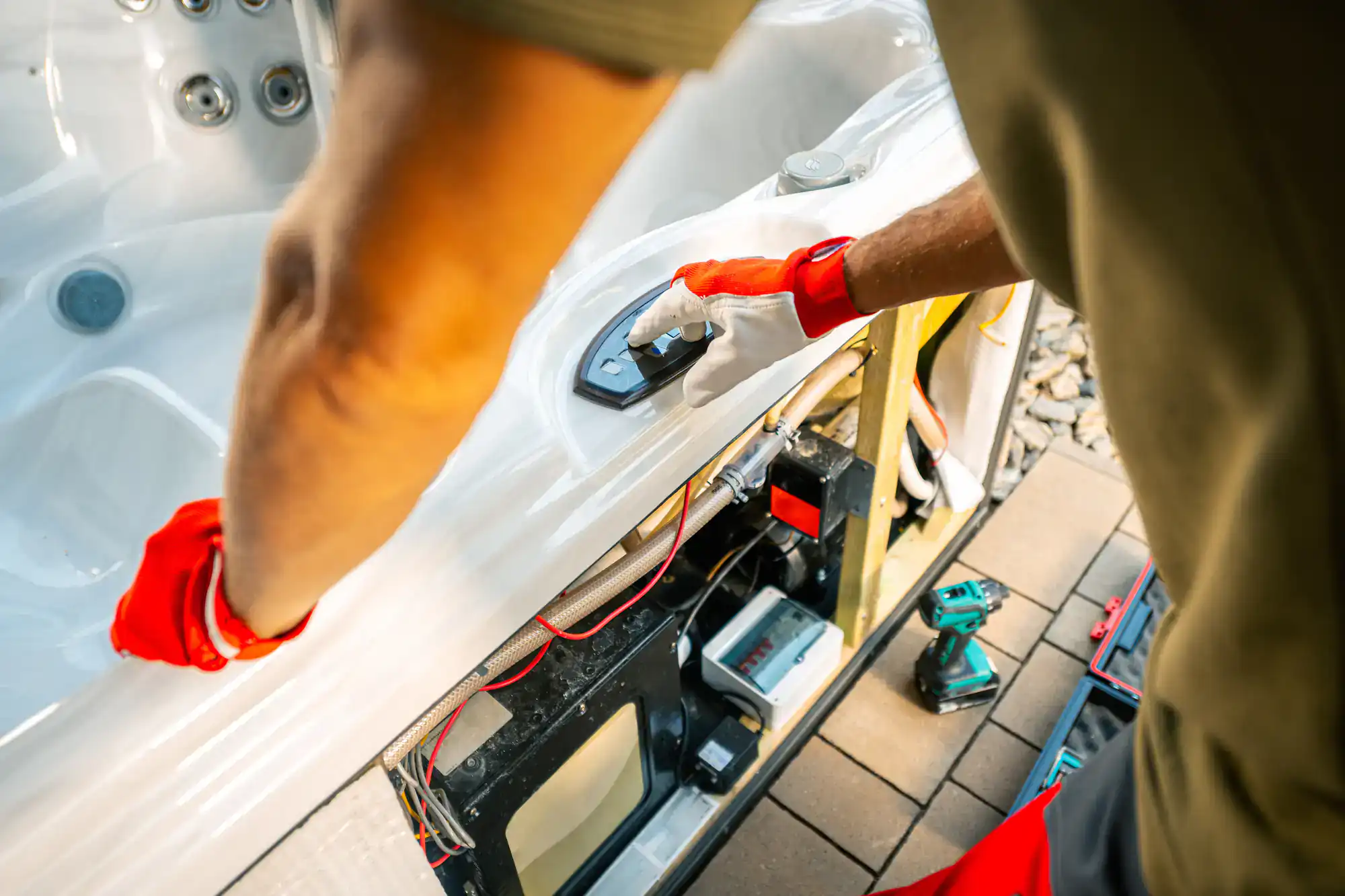
Hot tub electrical installation is not a single task — it is a sequence of connected steps, and skipping any one of them creates a problem down the line. The dedicated 240V circuit means nothing else shares the breaker with your hot tub. The Class A GFCI breaker is what protects people from electrocution in a wet environment — it detects ground faults and cuts power in milliseconds. These are not optional extras. They are required by NEC Article 680 and the Oregon Electrical Specialty Code, and Deschutes County’s final electrical inspection will check for all of them.
The disconnect box placement matters too. It has to be installed no closer than 5 feet and no further than 15 feet from the hot tub, within line of sight, and in a weatherproof enclosure. At Sisters’ elevation, with the freeze-thaw cycles this area sees through the winter months, that outdoor-rated enclosure needs to be the right spec — not just whatever is cheapest at the supply house.
Equipotential bonding is the step that often gets skipped by unlicensed contractors and handymen. Every metal component connected to the hot tub — the water, the pump housings, the metal fittings — has to be bonded together so there is no voltage difference between them. It is invisible once the job is done, but it is the difference between a safe installation and a hidden shock hazard. We do every step, pull the Deschutes County permit, and stand behind the full installation with a 5-year labor warranty.
Who handles electrical permits for hot tub installations in Sisters, Oregon?
The City of Sisters does not administer its own building or electrical permits. Instead, the city contracts those services out to the Deschutes County Building Safety Division. That means if you are having a hot tub wired at a property inside Sisters city limits — or in an unincorporated community nearby like Tollgate, Crossroads, or Black Butte Ranch — the permit comes from Deschutes County, not a city building department. Their number is (541) 388-6574.
This catches a lot of homeowners off guard, especially people who have dealt with city permit offices in Portland or other larger markets. The process itself is not complicated, but knowing who to call and how to get a contractor listed on the permit before the final inspection is scheduled is important. We handle all of this as part of the installation — you do not need to navigate the county process yourself.
Does my electrical panel actually support a hot tub, or will I need an upgrade?
This is one of the most common questions before a hot tub installation, and the honest answer is: it depends on your panel. A standard 240V hot tub requires a dedicated 50-amp circuit. If your panel is already close to capacity — or if you are in an older home in a community like Tollgate or Crossroads where 100-amp service panels were common in homes built through the 1980s and early 1990s — there may not be enough headroom to add that circuit without an upgrade.
The only way to know for certain is to have a licensed electrician assess the panel before the work starts. We include this assessment as part of every free estimate. If an upgrade is needed, you will get a clear quote for the full scope — the hot tub circuit and any panel work required — before anything is scheduled. No surprises once the job is underway.
Can I legally wire a hot tub myself in Oregon, or does it require a licensed electrician?
In Oregon, a 240V hot tub installation is not a homeowner-permitted activity in most jurisdictions. Oregon law requires a licensed electrician for this type of work, and Deschutes County — which administers permits for Sisters — requires a licensed contractor to be listed on the permit before the final electrical inspection can be scheduled. That means a DIY installation or one done by an unlicensed handyman cannot be legally inspected or signed off.
Beyond the legal side, the safety margin for error in a wet electrical environment is essentially zero. A GFCI breaker that is wired incorrectly, a bonding connection that is missed, or a disconnect box that is not properly weatherproofed for Sisters’ winters can create hazards that are not visible until something goes wrong. Most hot tub manufacturers also void the warranty if the electrical installation was not performed by a licensed professional. The permit and inspection process exists to protect you — and skipping it creates real liability if you ever file a homeowner’s insurance claim or sell the property.
What is a GFCI breaker and why does a hot tub specifically require one?
A standard circuit breaker protects equipment by cutting power when a circuit is overloaded. A GFCI breaker — which stands for ground fault circuit interrupter — does something different. It monitors the flow of electricity through the circuit and cuts power within milliseconds if it detects that current is leaking outside the intended path. In a dry environment, that might just trip a breaker. In a hot tub full of water, that leaking current can be the difference between a minor shock and a fatality.
NEC Article 680, which governs all hot tub electrical installations in the US, requires a Class A GFCI breaker on every outdoor spa and hot tub — no exceptions. The Oregon Electrical Specialty Code, updated in October 2023, incorporates these requirements. Deschutes County’s final inspection will verify the GFCI breaker is correctly installed and functioning. We install the right breaker for your specific hot tub’s amperage rating as a standard part of every installation.
How does Sisters' climate affect outdoor hot tub electrical installations over time?
Sisters sits at 3,189 feet, and the winters here are genuinely cold — January overnight lows average in the low-to-mid 20s, and the area sees real snowfall and freeze-thaw cycles through the winter months. That matters for outdoor electrical components in ways that a Portland-area installation does not have to account for.
Conduit that is not properly sealed can allow moisture in, which freezes and expands and damages the conduit or the wire inside it over time. Disconnect boxes that are not rated for the temperature swings this area sees can develop seal failures. Connections that were not torqued correctly can loosen through repeated thermal expansion and contraction. A quality hot tub electrical installation in Sisters uses weatherproof, outdoor-rated components throughout — not just at the obvious points — and the connections are made to hold up through years of high-desert winters, not just the first season. Our 5-year labor warranty covers the full installation, so if anything in the electrical work fails within five years, it is covered.
Does a hot tub electrical installation affect my homeowner's insurance or home resale value in Sisters?
Yes, and in ways that are worth understanding before the work starts. Most homeowner’s insurance policies require that electrical work be permitted and inspected to be covered. If a hot tub was wired without a permit — or by an unlicensed contractor who skipped the Deschutes County inspection process — and something goes wrong, the insurer can deny the claim on the grounds that the installation was not code-compliant. That applies whether the issue is a fire, a shock incident, or water damage related to a failed electrical component.
On the resale side, unpermitted electrical work tends to surface during the buyer’s inspection. Sisters’ real estate market has been active, with sellers receiving close to asking price — but an unpermitted hot tub installation is the kind of thing that comes up in due diligence and either kills a deal or gets negotiated down. A permitted, inspected installation with a clean record through Deschutes County is an asset, not a liability. It shows the work was done correctly and gives the next buyer confidence that the hot tub is safe to use.
Useful Links