
Hot Tub Electrical Installation in Vancouver, WA
Vancouver Winters Are Long — Your Hot Tub Wiring Should Be Ready for All of Them

Hear from Our Customers
Hot Tub Electrician in Vancouver, WA
Vancouver gets around 41 inches of rain per year, and from October through March, the grey sets in hard. December alone averages nearly 20 rainy days. For most Vancouver homeowners, a hot tub isn’t a summer luxury — it’s a way to actually use the backyard during the six months when the weather makes that otherwise impossible. The wiring is what determines whether that works or doesn’t.
When the electrical installation is done correctly — proper dedicated circuit, GFCI protection, code-compliant disconnect, equipotential bonding on all metal components — your hot tub runs reliably every time you flip the switch. No tripped breakers on a cold Tuesday night. No warranty headaches six months in. No failed inspection when you go to sell the house.
That matters more in Vancouver than people realize. A lot of homes in neighborhoods like Hazel Dell and Orchards were built in the 1960s and 70s with 100-amp panels that were never designed to carry a 50-amp dedicated hot tub circuit. Discovering that after your tub is sitting in the driveway is a bad day. Catching it during a free estimate before delivery — that’s just good planning.

Ready to get started?

Hot Tub Wiring in Vancouver, WA
Young Electric LLC is a veteran-owned, family-operated electrical company serving the Portland Metro and Clark County, including Vancouver, WA. Jeremy Young is a second-generation electrician and military veteran who built this company on the same values that defined his service — show up, do the work right, and stand behind it. The team carries over 40 years of combined experience across both generations.
With a 4.8-star rating across more than 1,400 Google reviews and a BuildZoom score that places us above 99% of Oregon contractors, the track record is there. More importantly, every hot tub electrical installation comes backed by a 5-year labor warranty — which is rare in this market and means something real when you’re counting on your setup to hold up through Clark County winters year after year.
We hold the Washington State licensing required to pull permits and perform legal electrical work in Vancouver. Whether your property falls under City of Vancouver jurisdiction or Washington State L&I, the permit process is handled as part of the job.

240V Hot Tub Wiring in Vancouver, WA
The best time to call is before your hot tub is delivered. We offer free estimates, and the first thing we assess is your panel. In Vancouver, this step matters more than most homeowners expect.
Homes in Fishers Landing or Salmon Creek with newer 200-amp panels are usually straightforward. Homes in Hazel Dell, Orchards, or Fourth Plain with older electrical systems often need a subpanel or panel upgrade before a dedicated 50-amp circuit can be added. Knowing that before delivery day saves you a lot of frustration.
Once the panel situation is confirmed, we cover everything: running the dedicated 240V circuit, installing the conduit and wet-rated wiring to the tub location, setting up the GFCI breaker, mounting the outdoor disconnect panel within line of sight of the tub, and completing the equipotential bonding on all metal components. Every step follows NEC Article 680 and Washington State WAC 296-46B requirements.
We handle permits for you. In Vancouver, that means knowing whether your address falls under the City of Vancouver Building Department or Washington State L&I — because those are two different agencies, and Clark County itself does not issue electrical permits. We navigate that split as part of the process, coordinate the final inspection, and leave you with a completed, inspected installation.
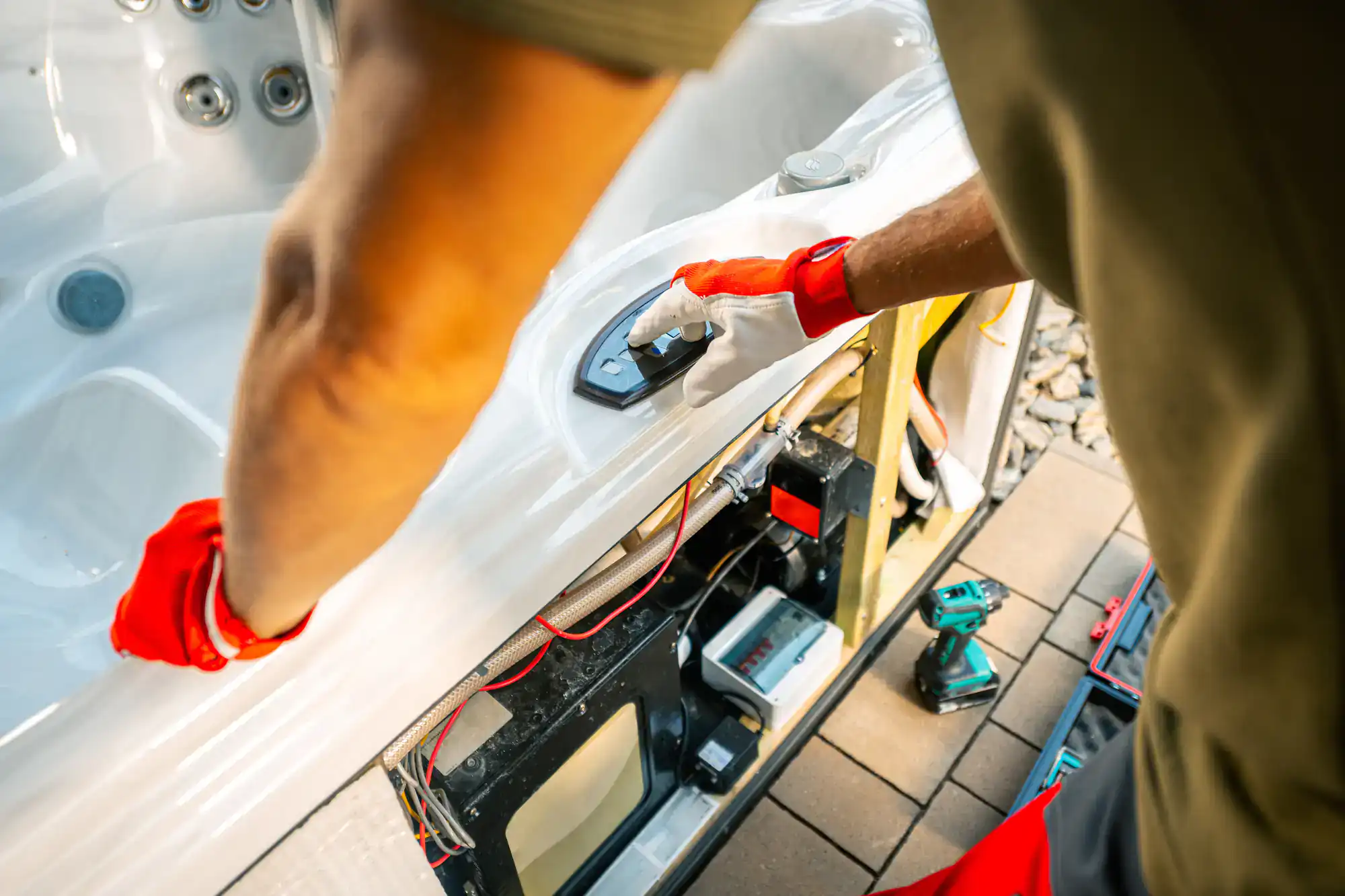
GFCI Breaker for Hot Tub in Vancouver, WA
Hot tub electrical installation in Vancouver, WA involves more moving parts than most homeowners anticipate going in. We cover the full scope — no handoffs, no gaps, no “you’ll need to call someone else for that part.”
The installation includes a dedicated 240V/50A circuit with a 2-pole GFCI breaker, copper conductors sized for the load and the run length, weatherproof conduit buried to code depth, and an outdoor disconnect panel installed within the required line-of-sight distance from the water. Equipotential bonding — which connects all metal components to equalize voltage and is one of the most commonly skipped steps in this type of work — is included as standard. So is permit acquisition and inspection coordination.
For Vancouver properties specifically, the installation also accounts for the Pacific Northwest climate. Wiring is wet-rated, conduit connections are sealed for outdoor exposure, and the disconnect is weatherproofed for the kind of sustained rain Clark County gets from fall through spring. Most hot tub manufacturers void their warranties if a licensed electrician didn’t do the wiring — so beyond the safety and code compliance piece, a proper installation protects the investment you made in the tub itself. We also back all labor with a 5-year warranty, which covers you well past the point where most other electricians’ guarantees have already expired.
Do I need a permit for hot tub electrical installation in Vancouver, WA?
Yes, and the permit process in Vancouver is a little more layered than most homeowners expect. If your property is inside Vancouver city limits, your electrical permit comes from the City of Vancouver Building Department. If your property carries a Vancouver mailing address but sits in unincorporated Clark County — which is more common than people realize — the permit goes through Washington State L&I. Clark County itself does not issue electrical permits.
This split catches homeowners off guard, and it catches some out-of-area contractors off guard too. We handle the permit process as part of every installation, including identifying which agency covers your address and coordinating the required inspection. You don’t need to navigate that on your own. Skipping the permit isn’t a real option either — unpermitted electrical work creates problems at resale and can complicate insurance claims if something goes wrong down the line.
What electrical work is actually required to hook up a 240V hot tub?
A full-size 240V hot tub needs a dedicated circuit — meaning it can’t share a breaker with anything else in your home. That circuit typically runs on a 2-pole 50-amp GFCI breaker, though some models require 40 or 60 amps depending on the pump count and heater size. The wiring runs from your main panel or subpanel through weatherproof conduit to the tub location, and a disconnect panel needs to be mounted within line of sight of the hot tub — at least 5 feet from the water’s edge but no more than 50 feet away.
There’s also equipotential bonding, which connects all the metal components around the tub to equalize voltage. It’s a code requirement under NEC Article 680 and Washington State WAC 296-46B, and it’s one of the steps that gets skipped most often in improper installations. Every one of these components — the breaker, the conduit, the wiring, the disconnect, the bonding — is part of what we install as a complete job, not a la carte.
My Vancouver home is older — will my electrical panel handle a hot tub circuit?
It depends on your panel, and it’s worth finding out before you buy the tub rather than after. A lot of homes in Vancouver’s older neighborhoods — Hazel Dell, Orchards, Fourth Plain, parts of Minnehaha — were built in the 1960s and 70s with 100-amp electrical service. Those panels often don’t have an open 50-amp slot available, and even when they do, the overall service capacity may not support the additional load a hot tub draws continuously.
In those situations, the solution is usually a subpanel installation or a full panel upgrade, which adds to the project scope and cost. Homes in newer areas like Fishers Landing East or Salmon Creek typically have 200-amp panels with available capacity, making the circuit addition more straightforward. Our free estimate includes a panel assessment so you know exactly where you stand before committing to anything. If an upgrade is needed, we’ll tell you upfront — not after the tub is already sitting in your backyard.
Can an Oregon-licensed electrician legally do electrical work in Vancouver, WA?
Not without also holding Washington State credentials. Oregon’s CCB license authorizes electrical work in Oregon only — it does not cross the Columbia River. Any electrician performing electrical work in Vancouver, WA needs a Washington State L&I electrical contractor license, and the permits for that work are issued under Washington State authority, not Oregon’s.
This is worth asking about directly before you hire anyone. An electrician who’s licensed in Oregon but not Washington cannot legally pull a permit for your Vancouver installation. If the work gets done without the right licensing and permitting, you’re left with unpermitted electrical work that can surface as a problem when you sell the home or file a homeowner’s insurance claim. We hold the Washington State licensing required to work legally in Vancouver and throughout Clark County, and we pull the permits as part of every job.
When is the best time of year to schedule hot tub electrical installation in Vancouver, WA?
The honest answer is: earlier than you think. Most Vancouver homeowners start thinking about hot tub installation in the fall, right when the rain picks back up and the backyard starts feeling unusable. But fall is also when electricians get busy, permit timelines stretch out, and scheduling gets tight. If you want your hot tub running by October or November — which is exactly when you’ll want it most — planning in late spring or early summer gives you the best shot at a smooth timeline.
Spring is also a natural planning window because it’s when most backyard improvement projects get kicked off in Vancouver. The weather breaks, homeowners start thinking about how they want to use their outdoor space, and the permit process has more breathing room. That said, we take installations year-round. If your tub is already purchased and sitting in the driveway in December, we’ll work with you — it just helps to know that the earlier you call, the more flexibility you have.
Does improper hot tub wiring void the manufacturer's warranty on the tub itself?
Yes, and it’s one of the details that catches Vancouver homeowners off guard after the fact rather than before. Most hot tub manufacturers require that a licensed electrician perform the electrical installation as a condition of the warranty. If the wiring was done by an unlicensed person — or by someone licensed in Oregon but not authorized to work in Washington — and something goes wrong with the tub, the manufacturer has grounds to deny the warranty claim entirely.
Beyond the warranty question, improper wiring in a water environment carries real safety consequences. The Consumer Product Safety Commission tracks hundreds of spa-related injuries each year tied to faulty electrical installations. GFCI protection, proper bonding, and correct wire sizing aren’t optional extras — they’re what keeps the installation safe for everyone who uses it. A licensed installation from Young Electric LLC protects the tub’s warranty, satisfies Washington State code requirements, and gives you a 5-year labor warranty on top of that — so you’re covered on multiple fronts, not just hoping nothing goes wrong.
Useful Links