
Hot Tub Electrical Installation in Cottage Grove, OR
Cottage Grove Homes Deserve Wiring That Actually Holds Up
Hear from Our Customers
Hot Tub Wiring Cottage Grove, OR
Cottage Grove gets cool and wet from October through April—and that’s exactly when a hot tub earns its keep. If you’ve been hiking the Row River Trail or spending a weekend out at Cottage Grove Reservoir, coming home to a properly wired, fully functional hot tub isn’t a luxury. It’s just a smart way to live in this part of Oregon.
The goal is straightforward: your hot tub works every time you want it to, without tripped breakers, failed inspections, or callbacks.
A big part of what makes hot tub wiring in Cottage Grove different from newer suburban markets is the housing stock. Homes near the historic downtown—the bungalows and craftsman-style houses that give this town its character—were built long before 240V hot tub circuits were part of anyone’s plan. That means your panel situation matters before anything else.
When we show up for your free estimate, assessing your panel is the first step, not an afterthought. You’ll know exactly what your home needs and what the job involves before any work begins.
Once the wiring is done correctly—dedicated 240V circuit, properly sized GFCI breaker, weatherproof disconnect placed at the right distance, and bonding done to code—you’re not just getting a hot tub that runs. You’re getting an installation that’s permitted, inspected, and backed by our 5-year labor warranty. That’s the kind of outcome that holds up whether you’re in the tub in November or selling the house five years from now.

Ready to get started?

Licensed Hot Tub Electrician Cottage Grove
Young Electric LLC is a second-generation, family-owned electrical contractor serving Oregon homeowners with more than 40 years of combined experience behind every job. Jeremy Young grew up in this trade—which means the knowledge behind your hot tub installation isn’t borrowed from a training manual. It comes from decades of real work across Oregon’s varied housing stock, panel configurations, and local code requirements.
In Lane County, that experience matters. Cottage Grove’s mix of older homes near the historic downtown core and newer construction on the city’s edges means no two jobs look the same. We hold both an active CCB license and a BCD electrical license—Oregon’s two required credentials—and have pulled more than 3,224 verified building permits statewide. That track record puts us in the top 1% of all licensed contractors in Oregon, according to BuildZoom.
With a 4.8-star rating from more than 1,400 Google reviews, our reputation speaks for itself. Customers consistently mention clear communication, on-time arrival, and honest explanations—the kind of experience that matters in a community like Cottage Grove.

240V Hot Tub Wiring Process Cottage Grove
It starts with a free estimate visit. Before any pricing is discussed, we look at your electrical panel to determine whether your current service can support a dedicated 240V hot tub circuit. This step matters more in Cottage Grove than in newer markets—a lot of homes in and around the historic downtown were built with 100-amp service panels that weren’t designed for this kind of load.
If an upgrade is needed, you’ll know upfront, not mid-job.
Once the scope is clear, we file the permit through the City of Cottage Grove’s Community Development Department using Oregon’s ePermitting system. You don’t have to figure out the city’s permit application or track down the inspection line. We handle that process.
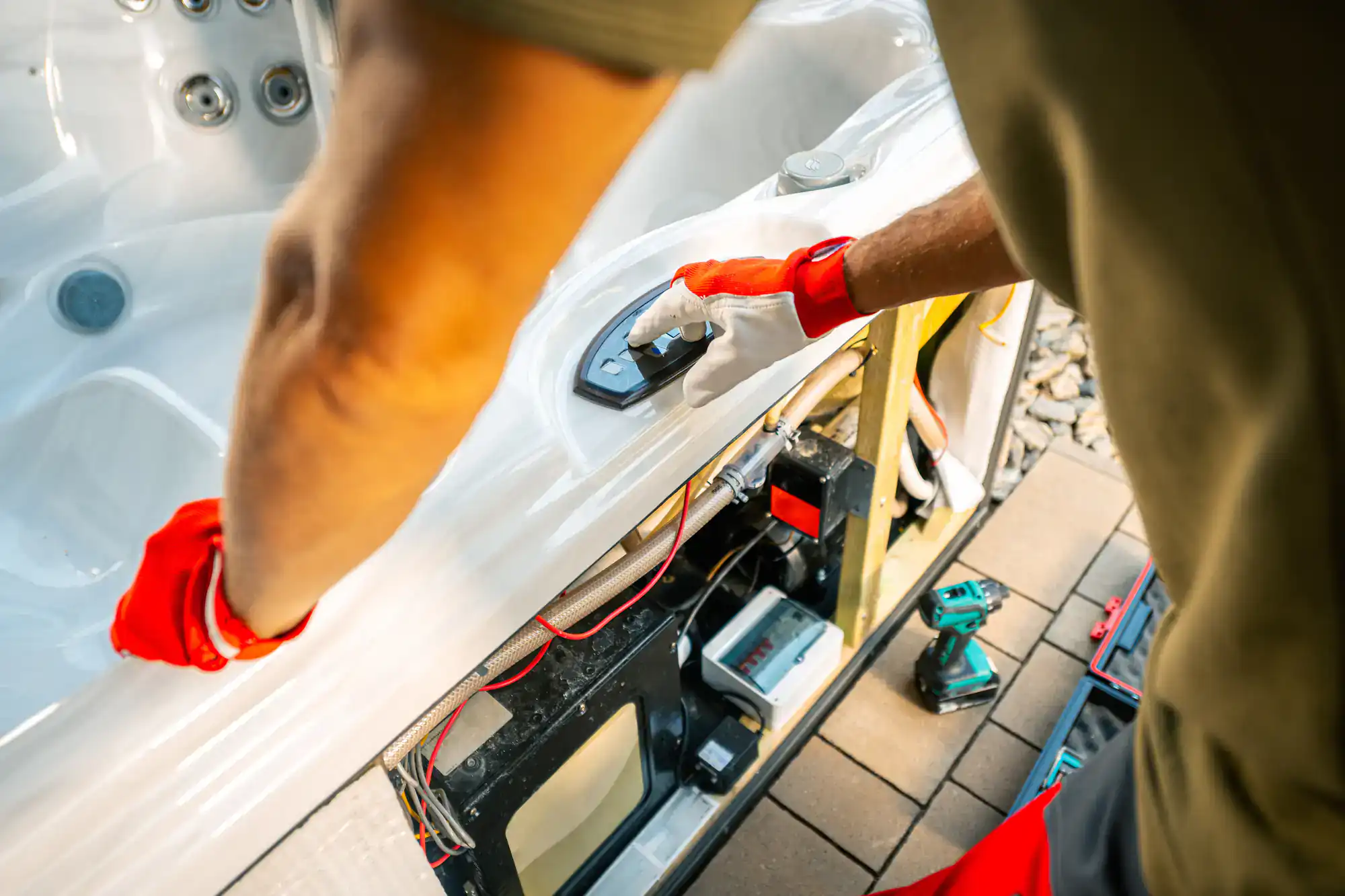
The electrical work itself involves running a dedicated circuit from your panel to the hot tub location, installing the properly sized GFCI breaker, setting the weatherproof disconnect at the code-required distance, and completing the equipotential bonding of all metal components. That last step is one that unlicensed or low-bid contractors routinely skip—and in a wet environment, it’s the one that actually protects people.
After the work is done, a city electrical inspector signs off on the installation. That inspection is your documentation—for your homeowner’s insurance, for the hot tub manufacturer’s warranty, and for any future buyer of your home. The job isn’t finished until it passes. And with our 5-year labor warranty covering every installation, if something isn’t right, it gets made right.

Hot Tub Electrical Wiring Services Cottage Grove, OR
Every hot tub electrical installation by Young Electric LLC covers the full scope of what Oregon code and your hot tub manufacturer require. That means a dedicated 240V circuit—nothing shared, nothing borrowed from an existing outlet—with a 50-amp GFCI breaker sized to the load.
The GFCI protection isn’t optional and it’s not the same as a standard breaker. In a wet environment, it’s the component that cuts power in milliseconds if something goes wrong. A regular breaker protects equipment. A GFCI breaker protects people.
The installation also includes a weatherproof disconnect box placed at the code-required distance from the tub—close enough to be accessible, far enough to meet NEC Article 680 requirements—and full equipotential bonding of all metal components in and around the hot tub.
For properties along Row River Road or near Cottage Grove Reservoir where the hot tub location is farther from the main panel, we handle underground conduit runs as part of the job. Trenching and burying conduit is the cleanest and most code-compliant approach for longer runs, and it’s part of what separates a proper installation from a shortcut.
The permit and final inspection through the City of Cottage Grove are included in the process—not an add-on, not something you handle separately. Every installation is done to the 2023 Oregon Electrical Specialty Code, which went into effect October 1, 2023. And every installation is backed by our 5-year labor warranty—something you won’t find offered by other local electricians currently serving the Cottage Grove area.
Do I need a permit for hot tub electrical installation in Cottage Grove, OR?
Yes—a permit is required for hot tub electrical installation in Cottage Grove, OR. The City of Cottage Grove’s Community Development Department handles electrical permits through Oregon’s ePermitting system, and a licensed electrician must perform the work.
Skipping the permit isn’t just a code violation—it creates real problems down the road. If you ever file a homeowner’s insurance claim related to the hot tub or its wiring, an unpermitted installation can result in denied coverage. And when it comes time to sell your home, an unpermitted electrical installation shows up as a liability that buyers and their inspectors will flag.
We pull the permit and schedule the inspection as part of every job. You don’t have to navigate the city’s process or figure out the inspection line—that’s handled. The final inspection by a city electrical inspector is what puts the installation on record as safe, code-compliant, and documented. That documentation protects you in ways that matter long after the hot tub is running.
What size breaker does a 240V hot tub need, and does a GFCI breaker matter?
Most 240V hot tubs require a dedicated 50-amp circuit with a GFCI breaker—though some models specify 60 amps, so the hot tub’s manual is the starting point for that number. The GFCI requirement is not optional. NEC Article 680 mandates GFCI protection on all outdoor spas and hot tubs, and Oregon’s Electrical Specialty Code follows that standard.
The reason it matters so much in a wet environment is straightforward: a standard breaker trips when a circuit is overloaded. A GFCI breaker detects ground faults—the kind of electrical fault that happens in or near water—and cuts power within milliseconds. That’s a fundamentally different level of protection.
A lot of homeowners ask whether they can use an existing breaker or share a circuit with something else in the yard. The answer is no. Hot tubs require a dedicated circuit—nothing else on that breaker, ever. We confirm the correct breaker size for your specific hot tub model during the estimate visit and install accordingly.
My Cottage Grove home is older—will my electrical panel handle a hot tub?
This is one of the most common concerns for homeowners in Cottage Grove, OR, and it’s a legitimate one. A lot of the homes near the historic downtown core—the bungalows and craftsman-style houses built in the 1950s through 1970s—were originally wired with 100-amp service panels. A 240V hot tub circuit draws 50 amps on its own.
If your panel is already running close to capacity, adding a hot tub circuit without an upgrade isn’t safe and won’t pass inspection.
The good news is that you don’t have to guess. We assess your panel as part of every free estimate visit. If your current panel can handle the addition, you’ll know. If it needs an upgrade, you’ll get a straight answer on what that involves before any work begins.
Homes on the newer edges of Cottage Grove—the subdivisions built in the 1990s and later—typically have 200-amp panels and are more likely to accommodate a hot tub circuit without additional work. But every home is different, and the only way to know for certain is to have a licensed electrician look at it.
How long does hot tub electrical installation typically take?
For a straightforward installation—where the panel has capacity, the run from the panel to the hot tub location is relatively short, and no trenching is needed—the work itself typically takes four to eight hours. That’s the range for a licensed electrician completing the circuit, installing the GFCI breaker, setting the disconnect box, and completing the bonding.
The permit and inspection add time to the overall timeline, but not to the day of work.
For properties in Cottage Grove where the hot tub is farther from the main panel—homes on larger lots along Row River Road or rural-adjacent properties near Dorena Lake, for example—the job takes longer because the conduit run is longer and trenching may be involved. We give you a clear scope and timeline during the estimate visit so you know what to expect. The goal is to have your hot tub ready before the fall rains settle in for good—and getting the estimate scheduled early in the season is the best way to make that happen.
Can the hot tub dealer's electrician handle the wiring, or should I hire separately?
Hot tub dealers often have an electrician they recommend—sometimes even one they present as part of the purchase package. That arrangement isn’t automatically a problem, but it’s worth understanding what you’re agreeing to.
The dealer’s electrician may quote low because they’re cutting corners: skipping the permit, skipping the inspection, or skipping the equipotential bonding step that NEC Article 680 requires. None of those shortcuts are visible once the tub is in and running—until something fails, a claim gets denied, or a home inspection surfaces the issue at resale.
Most hot tub manufacturers also have warranty language that requires installation by a licensed professional following applicable electrical codes. If the dealer’s electrician skips the permit and the installation doesn’t meet code, you may have voided your hot tub’s manufacturer warranty without realizing it.
Hiring a licensed, independently verified electrician—one who pulls the permit, passes the inspection, and backs the labor with a 5-year warranty like Young Electric LLC does—is the straightforward way to protect both the investment and the coverage.
What is equipotential bonding, and why does it matter for my hot tub?
Equipotential bonding is a requirement under NEC Article 680 that connects all metal components in and around the hot tub—the pump housing, metal fittings, water, and any metal within a certain distance of the tub—to a common grounding point. The purpose is to eliminate voltage differences between those components.
When there’s a voltage difference between, say, the water and a metal rail, current flows through whatever is bridging that gap—which can be a person. Bonding removes that risk by making sure everything is at the same electrical potential.
It’s also one of the steps that unlicensed contractors and handymen most commonly skip, because it’s not visible once the installation is complete and it requires understanding why it matters, not just how to run a wire. In Cottage Grove, where some homeowners turn to general handymen for electrical work to save money, this is a real gap.
We complete full equipotential bonding on every hot tub installation as a standard part of the job—not an upgrade, not an add-on. It’s required by code, and it’s what keeps the installation safe for everyone who uses the tub.
Useful Links